Chapter 4
Sales Is Always Personal
Ego states, trust, and why every sales conversation is a human conversation first. Parent, Adult, and Child dynamics in selling.
Many things have changed in sales since the time (very long ago) when I started. Back then, we didn’t have the tools and the guidance that teams do now to prepare for what could greet you on the other side of the sales call. But one thing stays the same: the dynamics between seller and buyer. It’s an interaction between people. And the person who’s in the driver’s seat is you, the seller.
The biggest bullshit idea I hear repeated is that the buyers have more knowledge going into the process. This is simply a lie that people love to throw in our faces to try to scare and intimidate us.
Your buyers have far less knowledge than you.
And it’s time we understand that and respect ourselves and all our hard work.
Let me explain. Buyers are considered to have more knowledge because they are more conditioned to a commodity purchase process, given the frequency and ease of purchasing just about everything these days in a commoditized and commercialized society. But the sellers have this much more buying experience too—we are consumers too! And the good news is that the sellers have even more knowledge thanks to the tools in our sales stack, the availability of training, and the ease with which an individual can take it upon themselves to improve. I mean, you’re reading this book, right?
So in reality, the advantage lies with the salesperson. When you dig deeper and seek to improve your skills and learn more about your craft, and you are willing to practice, you end up being in a better position than the person on the other side of the table. After all, how many of your customers actually take courses and buy books to learn how to be better at buying?
But don’t let this give you an attitude as you walk into the sales conversation. Watch your ego (more about that in a moment). Simply use this knowledge to help reset your courage and confidence in the career you’ve chosen to pursue. Respect yourself—you’ve earned the right. This is what we like to call an internal Respect Contract.
Your Whole Self
The old mantra of “leave your personal life at the door” when you walk into the office is not only old-school, it is simply wrong. Believe me—I used to live and coach to this mantra. It wasn’t until I started investing in my own personal therapy and learning about the dynamics of the human condition that I was able to relate what I was learning back to the business world. And then I realized that we are whole beings. We bring our whole self wherever we go.
At work, we bring our professional self. In social situations, we bring our personal self. We are often taught to separate the two to achieve happiness. I’d like to encourage people to shift the mindset. You bring your whole self with you everywhere you go. And rather than separate them, you can choose to focus on one part of your being for a period of time. Whether we are building a team or a family, whether we are building a relationship with a prospect or a partner, we are whole beings and everything engages with everything else. The lessons learned in one relationship can and should help shape and improve the other relationships we have. Sometimes it goes our way; sometimes it does not. And in all cases, our whole being is better.
It took me a long time, and a lot of personal and professional success and setbacks—probably more setbacks than success—to reach this understanding. Hopefully I can help some folks get there faster. And it started with a journey to improve my personal self over my professional self.
Back when I first started out in therapy, I was trying to heal from my childhood and upbringing. Just so folks don’t go wondering, “OMG, how bad was it?” I can assure you it was not all that bad. I was never abused, and my parents were not alcoholics or drug addicts. We were pretty typical for that time. My parents divorced when I was about ten, but it was amicable, no custody issues, and everyone still engaged in family gatherings and get-togethers. But that doesn’t mean I wasn’t affected. Like most people, I had some shit I had to deal with. Big props to my mom and dad for doing the work so that things could be relatively normal and for being very open and supportive throughout my journey.
And from that I started seeing a therapist. She changed my life, my whole life, my whole being. She helped me with my career and being a workaholic as well as my personal life. Without her I would not have my career, the ability to write this book, and most importantly my loving wife, two sons, and two dogs.
There were two early lessons my therapist taught me that I bring to the sales training world—what I teach and how I teach it.
First, she helped me understand what it means to respect yourself. Respect yourself based on where you are, not where you think you should be. In time, you can get to those other places; it’s just much harder if you do not have an internal Respect Contract.
Very early on, maybe the first or second session, she said, “We are going to have fun with this.” On the one hand I was like, “OK, that’s cool, I like fun.” On the other hand I was scared out of my mind and thinking, “What the fuck is going to be fun about me coming in here weekly and bawling?”
She was right: it was a lot of fun and continues to be to this day. What she knew and was trying to teach me, without giving it away, is that through my willingness to learn about myself, I was going to respect myself in ways I had never known—or at least remembered. It was my internal Respect Contract.
The second thing she taught me about was Transactional Analysis. I refer to this almost daily in my life, whether it’s with prospects, customers, my family, or, yes, even myself. Transactional Analysis is how I watch my ego—and my customers’ egos too.
Transactional Analysis: Parent, Adult, Child
Transactional Analysis is a theory and practice originated by Eric Berne, MD. It looks at the communication exchanges between people and theorizes that our childhood experiences have an immense impact on our lives as adults. (That might not be groundbreaking thinking nowadays, but back when I was diving into therapy it blew my mind.)
Berne suggested that during a conversation, we might unconsciously respond in ways that are influenced by past childhood experiences, anxieties, or emotions. He believed we have three different ways of interacting, or three different ego states: Parent, Adult, and Child. Berne believed that how we were raised affects how we develop our ego states.
When I first learned about this and let it sink in, I was blown away. It felt like when you’re cleaning a room in your house where everything’s sprawled all over the floor, covering every empty space, and you finally organize it and put it all away. You feel clear again. It was my first time truly connecting with and understanding myself. Not only did it help me heal some things I was struggling with internally, I found out how it gives us the key to understanding our personal and professional relationships, which is essential for creating Respect Contracts.
The ego states explain a lot of my work and how I approach my life and business, so let’s get a deeper understanding of how exactly it connects.
Here’s a quick and dirty explanation of Transactional Analysis.
The Child Ego: Beginning the Process
Feelings are a big part of the Child Ego state:
- It’s where our feelings and emotions are stored
- Win a deal and feel good
- Lose a deal and feel bad
- Excited about the new TV
- Heart breaks when someone ends a relationship
The Child Ego state essentially says, “I want it,” and this is where all decisions originate. It’s built upon reinforcement we were given as kids: positive or negative, how we can behave or can’t behave, what we get praise for or don’t, etc.
Your customer wants to speak with you. Your customer wants a demo, or maybe they want a discount. That’s their Child Ego speaking. Maybe you don’t want to believe me about where decisions originate, and that’s okay. It just means I proved the point—you don’t want to believe me.
The Child Ego is where the Buyer’s Experience begins.
The Adult Ego: The Rational Mindset
This is a more thoughtful state that weighs:
- Pros and cons
- Pluses and minuses
- Upside and downside
After considering the pros and cons of things, the Adult Ego gives us permission to move forward. Permission to pitch on a cold call, permission to set the first appointment, permission to send a contract. It’s the here and now of any interaction; it’s the place we operate from that allows us to listen fully, be more open, less quick to make harsh judgments. By the way, closed-ended questions force a rational mindset. Did you know that? See, that’s one right there.
The Adult Ego state gives us permission to move forward.
The Parent Ego: The Safety and Self-Reflective
The Parent Ego passes judgment:
- Right vs. wrong
- Appropriate vs. inappropriate
- Good vs. bad
The Parent Ego is the one that protects you; it helps you feel safe. It’s built upon reinforcements from our past, whether positive or negative, and affects our dayto-day interactions in the present. It’s the piece of us that conforms in order to be seen in a certain way, but it can also be our rebellious side.
The Ego States in Selling, Part I
What on earth does all this have to do with sales? It’s simple: sales is about people, and all people have these ego states. They are always there, and they’ll never go away. This is another example of the humanity in sales.
Now, keep in mind that nobody stays in a single ego state very long. In fact, it’s mere split seconds. We can start in a Child Ego state at the beginning of a sentence, shift into a Parent state midway through, and fall into an Adult state by the end. The states change instantly, without you even noticing in most cases.
Let’s say you want to craft a message to a prospect or client.
Child: You decide you want to craft a good message.
Parent: You write it and judge it, and judge it, and judge it.
Child: You don’t want to send the current version ’cause it sucks.
Adult: You start to rewrite it.
Parent: You judge again.
Adult: You craft a message you like.
Child: You want to send the message.
Adult: You give yourself permission to send the email.
See that whole conversation going on subconsciously with yourself? It happens within seconds. Now, imagine you write this email, and before sending it, you ask someone to take a look at it. They’re going to go through all of these ego states themselves. Now, imagine you’ve done the demo and it’s time for your prospect to go back and get it “reviewed as a team.” That’s a lot of ego states flying around. The process won’t always flow in the order described; it’s just an example to help you think and see how quickly they fluctuate.
So let’s see it from your prospect’s perspective:
Child: As the user of your product or service, they love it, they want it, but they may not have the juice to pull the trigger.
Child: Your prospect asks for a discount.
Adult: Final terms are agreed upon, and they tell you to send the contract over.
Child: They ask questions to compare you to your competition.
Parent: They take the competitive information and start judging it.
Adult: Based on competitive information, they decide to move forward with either you, your competitor, or neither of you.
Can you see how the ego states inform our conversations? The greatest practice is learning to be conscious about which state you’re operating from, and allowing yourself to change it. I really began focusing on how important the ego states were back when I was starting out in sales. The power dynamics in business conversations were incredibly important to me. After I’d worked with sales teams and been able to see from the inside out how they operate, it became apparent how often sellers are operating from an ego state that kills their confidence and doesn’t put them in a position of power. We’re used to giving up our power immediately because we believe we’re less than our prospects. If a sales rep is calling the CEO of a Fortune 500 company, they’re not going to think for a second that they’re operating on the same level as the CEO.
All of these ego states react with one another in different ways. Now think about being in a group sales call, where your prospect has three people, and you bring a team of three people. That is six people with their own ego states all flying around like crazy. They are always in play.
Now, I do not expect you to all of a sudden recognize the ego states in every call and conversation. My hope is to give you an inch of space between what your prospect is saying when they are in the Parent Ego state and what you are feeling in the moment.
Ego States in Selling, Part II
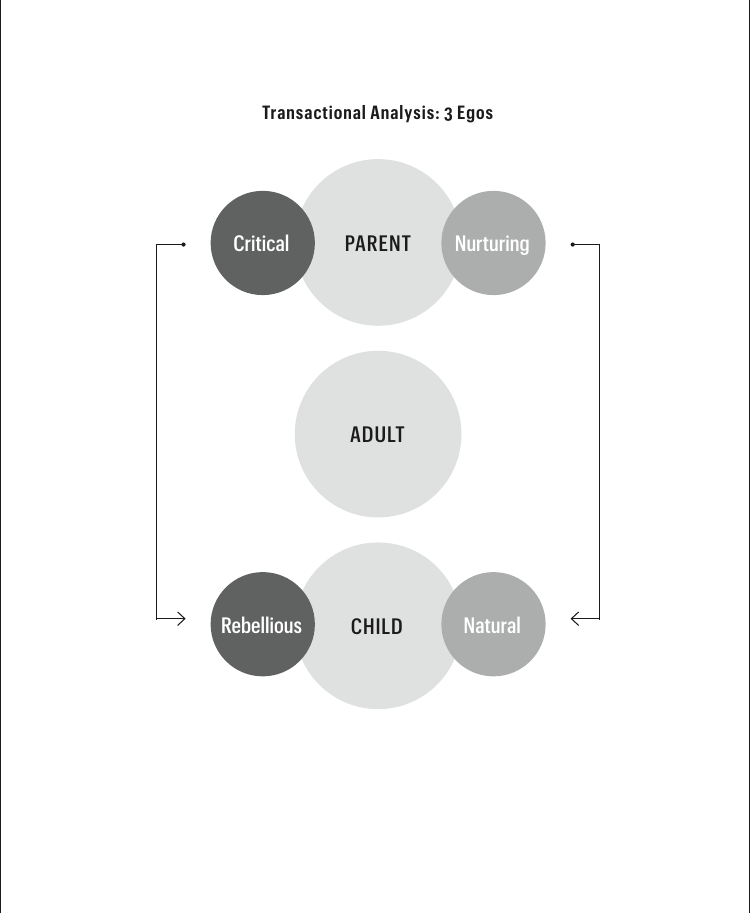
The Parent Ego can be broken down into two different sub-egos: the Critical Parent and the Nurturing Parent. The Child Ego also includes two sub-egos: the Natural Child and the Rebellious Child. (There is also an Adaptive Child sub-ego, as described below.)
The Critical Parent is exactly what you might think. It is that voice that is criticizing you, or perhaps you are interpreting it as critical. Your prospect may say, “Your competitor does this better than you” or “Why can’t you do it this way?” You can recognize it as the same tone you hear when your mom comes to visit and tells you how to reorganize your kitchen, even though you’ve been on your own for thirty-plus years. Sorry, Mom, not sorry. But I digress.
Now, because we grew up with our parents or parental figures, when we hear “the tone” we naturally fall into a Child Ego state. And that state is either the Rebellious Child, who wants to tell someone to fuck off, or the Adaptive Child, who is being driven by fear, guilt, or shame.
In the case of our prospect, we want to start handling their objections, and we are caught somewhere between the Rebellious and Adaptive Child.
Now on the other hand, there is the Nurturing Parent. This is also what you think: it’s the one who wants to help you solve a problem, fix the boo-boo, or find a way to work things out cordially.
And based on our upbringing, when we hear the Nurturing Parent, it most likely brings out the Natural Child. The Natural Child is, to put it simply, happy. It’s perhaps a pleasant state of mind in the present moment. And when we get excited because we are getting something we want, the childlike joy is more apparent.
In a business conversation, it might be something like the prospect simply asking, “Hey, do you think we can do ?” Tone of voice can have a lot to do with expressing the ego state in simple exchanges like this.
Now, here is the weird part to look out for. Sometimes when I hear the prospect being a Critical Parent, which of course then makes me want to be a Rebellious Child, I have to remember that they are often responding to me. Though they sound like a Critical Parent, they are probably being a Rebellious Child because they are not getting what they want. In the pricing and discounting conversation, they are often bouncing between Parent and Child Ego states. Their Parent is trying to be critical of you and your service, and their Child wants a discount.
It is also possible that we could say something in a way that’s simple—and, we hope, nurturing—but the prospect is hearing it as a criticism. One example of this would be when you have to deliver news the prospect does not want to hear. Perhaps a product issue, delayed release, or not being able to meet the pricing.
(And yes, email has made it much easier for everyone to be Critical Parents because they can hide behind their monitors and CPUs.)
One last example of the ego states. I am willing to bet most people reading this book sometimes feel like they have a closet full of nothing to wear. You may even have something in your closet that still has the tags on and you have never worn it. Maybe you bought it in a hurry and didn’t have time to try it on. Maybe you liked how it looked online, and then when it got to you, it wasn’t right.
Now, which ego state is preventing us from wearing these items? Parent? Partially. Adult? Maybe. But in most cases it’s the Child.
Remember, the Child is where our emotions are stored. It’s where buying decisions begin and end.
So why don’t we like the item? Is it because of how it looks? No. Is it because of how it fits? No.
It’s because of how it makes us feel. We don’t feel good in it. We may not like how it fits, which means we don’t like how it looks. But underneath all of this is how we feel about it.
Think about that with your prospects and customers. If they don’t feel good about your product or service, or if they don’t feel good about the Buyer’s Experience, then their Critical Parent will probably not think your product or service is appropriate, and therefore the Adult Ego state cannot give them permission to move forward.
Now, this is a lot to absorb. I don’t expect you to become a master of this information or recognize each ego state the moment it happens. But this knowledge can help you give yourself an extra inch of space between your brain and your heart. That space allows you to take a mental exhale and hopefully realize that people are people and none of us are perfect. This is an example of how we can actively bring humanity back into sales.
That’s the thinking we have to develop to have stronger sales conversations, which is why I focus so heavily on Respect Contracts.
Frequently Asked Questions
What is Transactional Analysis, and how does it apply to sales?
A theory developed by psychiatrist Eric Berne that says people communicate from three ego states, Parent, Adult, and Child, shaped by childhood experience. Richard applies it to sales conversations to explain why prospects, and reps, react emotionally in ways that don't always look rational on the surface.
What are the Parent, Adult, and Child ego states in selling?
The Child Ego holds emotion and is where buying decisions begin. The Adult Ego weighs pros and cons and grants permission to move forward. The Parent Ego judges right from wrong and reacts to protect or criticize. All three shift within seconds during a single conversation.
What's the difference between a Critical Parent and a Nurturing Parent in a sales conversation?
A Critical Parent voice, like pointing out what a competitor does better, tends to trigger a defensive Child Ego reaction in the listener. A Nurturing Parent voice, focused on calmly solving a problem, tends to bring out a more open, Natural Child response instead.
Do buyers actually know more than sellers going into a sales conversation?
Richard argues the opposite is usually true. Sellers who invest in training and tools typically have more relevant knowledge than most buyers, who rarely take courses or read books on how to buy well.
What is an "internal Respect Contract"?
Respecting yourself and your own expertise as a salesperson, based on where you currently are, not where you think you should be. Richard presents it as the personal foundation that has to exist before a rep can run an effective Respect Contract with a prospect.